Cart
0
You may also like

Everything else in the TriCamp range is supplier-sourced — carefully chosen, but made elsewhere. Our cowhide leather butane canister covers are the one exception. Those, we make ourselves, by hand, from full-grain cowhide leather. Here’s why that distinction matters and what it actually looks like in practice.

A butane canister is an ugly, utilitarian object — and a potentially dangerous one to leave rattling around loose in a pack next to sharp gear. A cover solves both problems, but only if it’s built to actually take the abuse of being packed, unpacked, dropped, and stored trip after trip.
Cowhide leather ages instead of degrading. It scuffs and scars and just looks more lived-in over time, instead of falling apart. We wanted at least one product in the leather collection where we controlled quality from the first cut to the final stitch — so we brought it in-house.

Every cover is cut, punched, stitched, and finished by hand. That means small variations from one cover to the next — a slightly different grain pattern, a stitch line that’s unique to that piece. It also means we catch and fix issues before a cover ever reaches you, something that’s harder to guarantee at arm’s length with an overseas supplier.

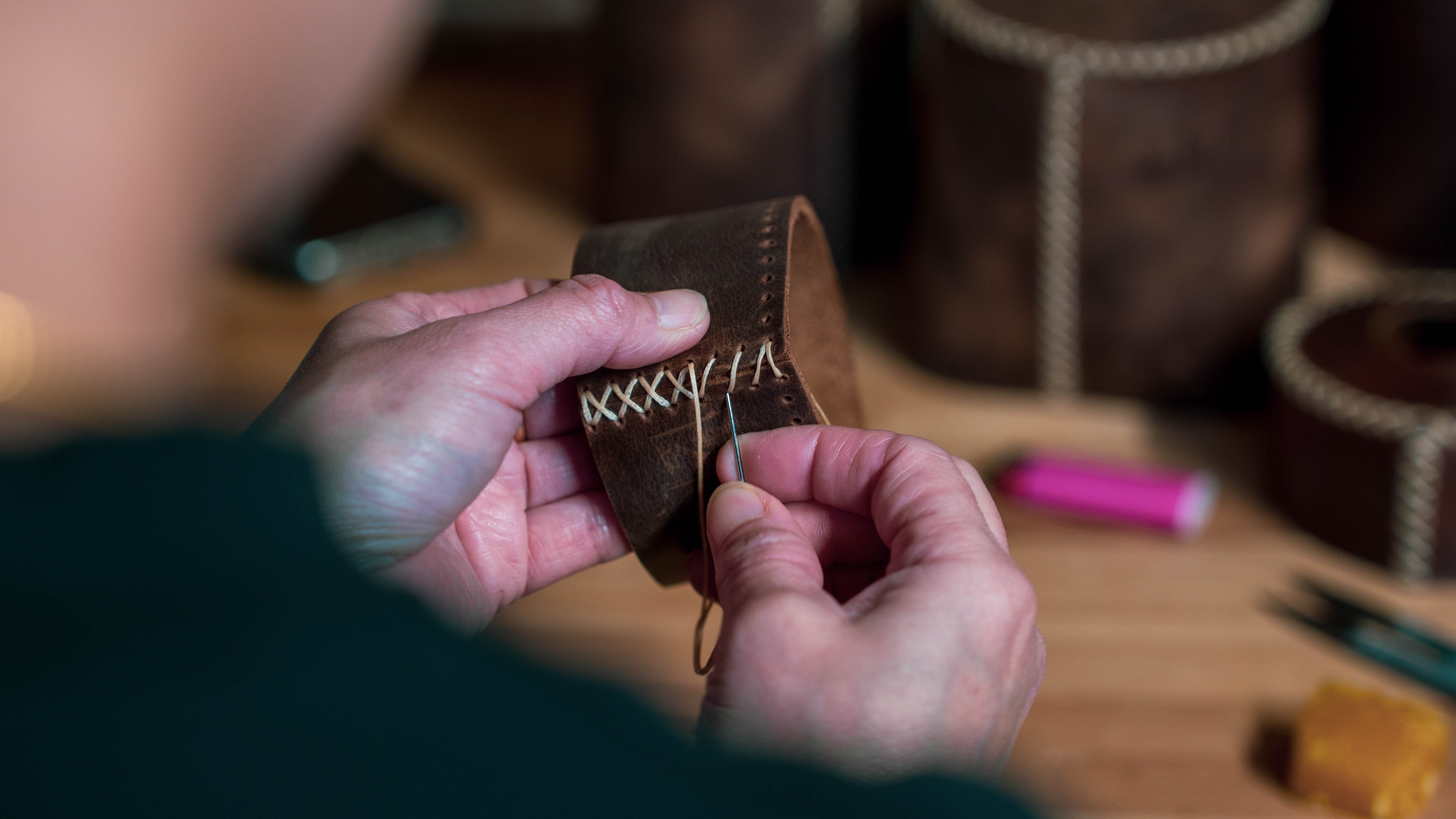
We use a cross-stitch technique along every seam. It’s slower than machine sewing, but it creates a stronger, more durable bond that won’t unravel if a single stitch breaks. Each cover takes its own time — and that patience is what separates handcrafted from mass-produced.
Each cover starts as a flat piece of full-grain cowhide. We cut each panel by hand to fit three standard butane canister sizes — 100g, 230g, and 460g. After cutting, we punch evenly spaced holes along every edge using a leather pricking iron.

The stitching is where each cover earns its character. We use waxed thread and a two-needle saddle-stitch method, pulling each stitch tight by hand to ensure even tension across the seam. The cross-stitch pattern along the top and side seams isn’t just decorative — it’s structural. It locks each stitch in place independently, so the whole seam holds even under the roughest use.

Once stitched, we finish every cover with a light burnish on the edges and a final inspection. The entire process — cut, punch, stitch, finish — is done by the same pair of hands, start to finish.

Our titanium cookware and cutlery and handcrafted wooden pieces make up the bulk of what we sell, and both are sourced from suppliers we trust. But the leather work is ours — stitch for stitch — and it’s the part of TriCamp we’re most hands-on with.
If you’re looking for gear that gets better with every trip, explore our leather butane canister covers — available in three sizes to fit 100g, 230g, and 460g canisters, starting from $18 AUD.
Browse the full Leather collection →

— The TriCamp Team